



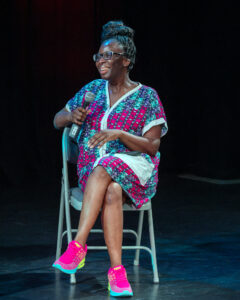
As we near the end of Black History Month, Maya Productions’ Ada Onyekwelu speaks with Lydia Idakula, Producer of M.A.B.E.L, about what Black History Month means to her and the wider conversation about representation within the arts sector.
 This year’s Black History Month theme, Honouring Our Communities, celebrates the people, relationships and networks that support us and help our communities thrive.
How do you honour the communities that have shaped you?
I think one of the most important ways I honour the communities that have shaped me is by making sure their stories are heard, seen and valued. Whether through theatre, film or cultural projects, I’m interested in the stories that might otherwise be overlooked, and in contextualising our histories, especially those that have been lost, silenced or deliberately buried.
My work has taught me that community isn’t just about where you come from; it’s also about the people who show up, open doors, share knowledge and cheer you on. And of course, you have to do the same for others. None of us gets anywhere alone!
How has your Nigerian heritage and/or culture influenced your work and the stories you choose to tell or are drawn to?
My Nigerian heritage influences pretty much everything I do, from the stories I’m drawn to, to how I understand community, identity and the world around me. I’m fascinated by our histories, our traditions, our contradictions, our values, our humour, our love for food and home, and the sheer creativity with which we navigate life. There’s so much more to our stories than what the world has traditionally been shown, and I’m interested in exploring the bits that have been overlooked, misunderstood or deliberately left out. I want to tell stories that entertain, challenge perceptions and make people curious enough to ask questions.
Through personal projects such as Queen Idia the Musical, you celebrate African history, creativity and identity. Why is it important to bring these stories to wider audiences?
Because our stories deserve to be told, and not just to us, but to the world. With Queen Idia the Musical, I’m interested in more than celebrating an incredible African queen. It’s about understanding the history behind the mask, the people and the culture it represents, and how that history connects to conversations we’re still having today. So much of African history has been told through someone else’s lens, and sometimes not told at all. Bringing these stories to wider audiences helps us reclaim our narratives, challenge assumptions and give people a fuller picture of who we are.
As a producer and writer committed to championing underrepresented voices, what changes would you like to see in the UK arts and cultural sector to create greater opportunities for Black artists and creatives?
I’d love to see a shift from simply making space for Black and Global Majority creatives to genuinely sharing power, resources and decision-making with us. Global Majority communities remain significantly underrepresented in the UK arts, particularly in leadership roles. We need better access to funding, networks and people who say yes with an open mind, allowing us to bring our differences, peculiarities and individuality without feeling the need to dilute who we are. We should feel that we belong, that we are deserving of the space, and that we have every right to shape, lead and build a sector that reflects us all.
What are you currently working on at Maya Productions?
At Maya Productions, I’m currently working on M.A.B.E.L, a new musical exploring the lives of an Anglo-Indian working class family who moved from India to Sheffield in the 1960’s. We’ve been through an R&D process and are now working towards a full production in 2027, with plans for a tour in 2028/2029. Alongside the musical, we are working on Routes to Roots, a project exploring heritage, identity and belonging through creative work with young people and communities. I love being part of such important work that creates space for stories and experiences that are not always represented, while helping people connect with their histories and see something of themselves in the stories we tell.
How does Maya Productions’ mission to increase global majority representation and create social change connect with the importance of Black History Month? In addition, what role can theatre play in challenging unhelpful narratives and shaping a more inclusive future?
I think they go hand in hand. Black History Month is an opportunity to celebrate our contributions, but also to recognise how much of our history, creativity and influence is still missing from the wider narrative. That connects very much to Maya’s work and every project we undertake. There is a real intentionality behind what we do, not just in the stories we choose to tell, but in the voices, perspectives and talent we bring into the room and the opportunities we create along the way. It’s something I’m particularly proud of.
Theatre has a wonderful way of bringing people into someone else’s world, sometimes making them laugh, sometimes uncomfortable, and hopefully leaving them thinking differently. It creates space for us to reclaim narratives, broaden perspectives and help audiences see the world through different eyes. Most importantly, it allows us to move beyond simply being included in someone else’s story to having the space to tell our own, on our own terms. And that, for me, is everything.